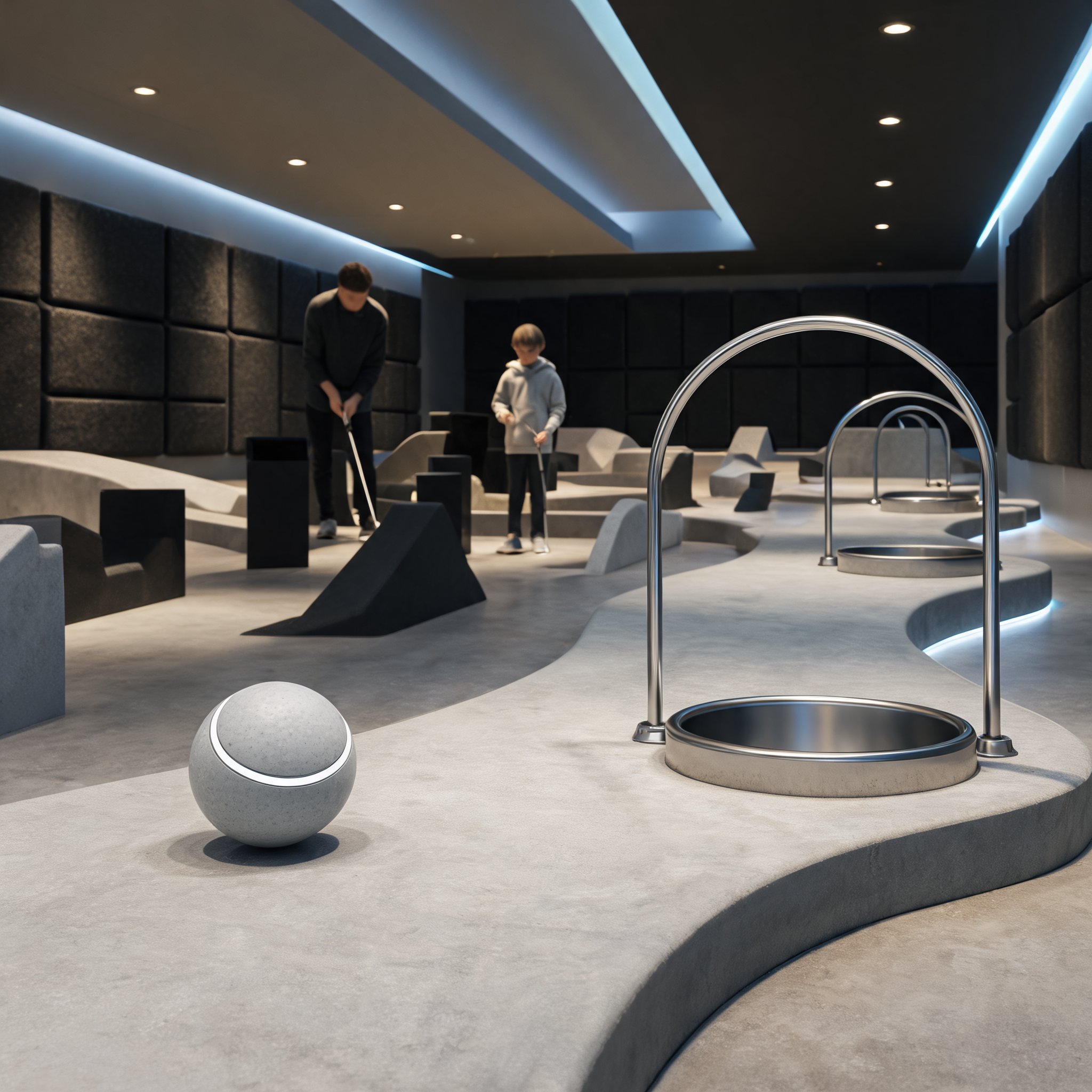
360Golf, a Holovis brand, is not trying to replace mini golf with a new attraction category. Its proposition is to keep the familiar putter-and-ball format and add automated scoring, gamified play and an analytics layer that operators can use to run the venue. That combination is the platform: a connected game system that can be installed as a retrofit, assembled from catalogue holes or built as a fully custom course.
Familiarity as the growth strategy
The team argues that mini golf's accessibility is the point. Stuart Edgington, global director of business development, says the game already has a base understanding in most markets, so 360Golf can build technology on top rather than teach a new behaviour. Visitors register, receive an assigned smart ball and start playing, which reduces explanation and staff time. The target is intergenerational demand: families, competitive-socialising young adults and corporate groups. For venue operators, that breadth matters because it gives one attraction multiple audiences and a stronger anchor for a visit.
The technology stack: scoring, play and data
At the base is automated scoring. Smart balls, tees and cups work with the HoloTrac system, removing paper scorecards and acting as a referee when competition is close. On top sits a suite of game mechanics: SuperShots that offer alternative ways to score, Triumphs that present awards and unlock challenges, plus bonuses, on-course games, player accounts, achievements, leaderboards and video celebrations. The intended effect is not only a better single round but a reason to return, compare scores and continue progressing across visits.
The operational layer is DeepSmarts, an AI analytics engine. It gives operators information on uptime, player interaction, seasonality and possible operational adjustments, and Holovis can use it to support product development. The commercial logic is to increase dwell time and secondary spend while keeping the guest journey simple: players use a kiosk, collect a ball and play, leaving staff to manage service, food and drink. 360Golf says a course can handle up to 80 people per hour. That throughput claim is central to the model, but it is a capacity figure, not proof of demand or margin at every site.
Modular deployment changes the economics
360Golf's flexibility is one of its stronger arguments. A technology-only package can be retrofitted into an existing mini golf attraction in about six to eight weeks. Catalogue holes can be installed and ready to play in eight to 12 weeks. Custom courses take six months or more. The range lets an operator test the format with limited construction, or commit to a destination attraction when the audience and location justify it.
- IP-led custom work: the Top 9 course at Netflix House uses fully custom holes and interactive elements, with themes including One Piece, Squid Game and Floor is Lava.
- Marine deployment: Norwegian Cruise Line's Tee Time installations use rugged, waterproof, IP-rated cups, tees and specialist screens. 360Golf has delivered four installations for the line.
- Large-format leisure: Butlin's PLAYXPERIENCE in Bognor Regis, a £15m project opened in 2024, contains three nine-hole courses: a neon-glow course, a Las Vegas-themed course and a wheelchair-accessible music-themed course.
- Multi-site consistency: Saudi Entertainment Ventures (SEVEN) can use the core technology to keep standards across locations while varying theming, layout or branding. Super Social in Leopardstown, Ireland, uses 12 holes from a sports-themed package.
Dobbs says Butlin's has seen 5,000 players in a busy week and gross revenue of around £40,000 per week. Those figures show what a high-traffic installation can look like, but they are company-supplied examples from one site; they should not be treated as a universal return forecast. Custom work also carries longer lead times, and retrofit projects depend on the constraints of the existing venue.
Design and inclusion are part of the product
The physical course is not a neutral container for the technology. 360Golf's creative, software and engineering teams work together on scenic pieces, lighting and playability. The appeal is visual as well as competitive: lighting layers make the holes feel spectacular, while the course still has to be fun and achievable. The Butlin's project added expertise in inclusive design. Courses can be configured for right- or left-handed play, putters can be sized for taller guests, tees can be placed near an edge for reach, and spacing between holes can reduce crowding and safety hazards. A lowered top cap at Butlin's lets wheelchairs get close to or onto the course.
Maintenance is part of the operating case. 360Golf says the system is designed for repairable, long-life use, and DeepSmarts can help engineers diagnose problems remotely by reviewing what happened on course. That support model matters for multi-site operators, who need consistency without sending specialists to every venue for routine issues.
The limits of the platform pitch
The wider competitive-socialising market is the backdrop, not a guarantee. Edgington expects the sector eventually to reach peak saturation, which is why Holovis is examining adjacent applications. The team is working on an integration with Roxy Leisure to add stroke counting to crazy pool tables and wants to apply its technology to other sports. That is an extension of the platform thesis, but it is still in development, not a proven second market.
The near-term test is whether 360Golf can convert its modularity into repeatable venue performance. Its pitch depends on the operator's audience, venue restrictions and commercial model, which is why the sales conversation is framed as a turnkey service rather than a course purchase. The company plans to present the offer at the Land Leisure & Tourism Show at NEC Birmingham on 4–5 November and at IAAPA Expo in Orlando on 16–20 November, with a playable demonstration at its Orlando office. The platform story is coherent; the evidence that matters will be whether operators can turn automated scoring and data into sustained visits, not just a strong first round.