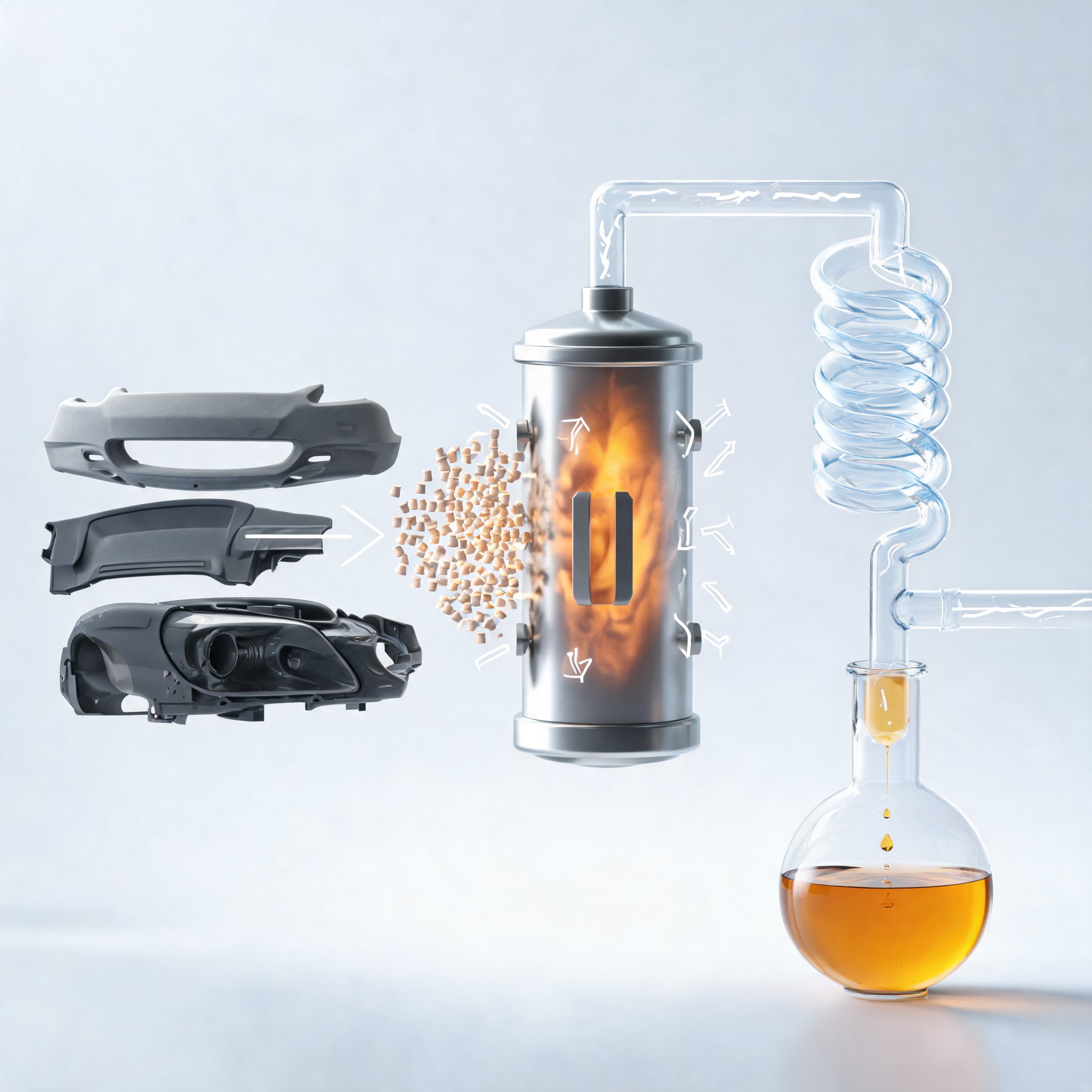
Recovering plastics from end-of-life vehicles (ELVs) sits at the center of efforts to improve resource recovery and move toward more circular use of plastics, and pyrolysis has emerged as one promising route for turning waste polymers back into fuels and chemicals. The process thermally decomposes plastics at elevated temperatures in the absence of oxygen, breaking polymer chains into liquid, gaseous, and solid products.
Earlier work has shown that pyrolysis can convert common automotive plastics such as low-density polyethylene (LDPE), high-density polyethylene (HDPE), and polypropylene (PP) into valuable hydrocarbons at relatively high yields. Much of that research, however, has centered on automotive shredder residue — a heterogeneous mixture of plastics, metals, textiles, and other materials — leaving less information about how plastics recovered directly from components such as dashboards, bumpers, and headlamps behave during pyrolysis. Automotive plastic waste (APW) can also carry mineral fillers, flame retardants, fiberglass, and other additives that affect degradation behavior and product composition.
Feedstock characterized before pyrolysis
In the study, researchers characterized plastics recovered directly from ELVs rather than relying on mixed shredder residue. The feedstock contained acrylonitrile butadiene styrene (ABS), high- and low-density polyethylene (HDPE and LDPE), polypropylene (PP), polystyrene (PS), and fiberglass, along with substantial volatile and ash fractions. Front and rear bumpers accounted for 86.6% of the sample by weight, and the fiberglass commonly used to reinforce automotive components contributed to the relatively high ash content. By characterizing the waste before performing pyrolysis, the team set out to address a gap in previous work.
Iron-pillared clay as catalyst
Instead of using bentonite clay in its original form, the researchers modified it through iron pillaring. That process introduces iron species into the clay structure, changing characteristics such as surface acidity and pore structure that can influence pyrolysis reactions. Iron-modified clays are attractive because they may improve oil production without relying on more expensive commercial catalysts.
The team compared thermal and catalytic pyrolysis across temperatures ranging from roughly 350°C to 521°C and catalyst loadings of about 6% to 34% by weight. A statistical experimental design allowed the researchers to evaluate the interaction between temperature and catalyst concentration.
Catalyst lifts yield, not composition
The catalyst strongly affected liquid yield. Catalytic pyrolysis produced an average oil yield of approximately 68%, compared with 41% for thermal pyrolysis alone. The highest oil yield, 78.6%, was achieved at about 416°C with a catalyst loading of roughly 24%.
The catalyst had much less influence on the composition of the resulting oil, however. Thermal and catalytic pyrolysis produced similar proportions of hydrocarbons within the C8-C24 range associated with gasoline- and diesel-range compounds. In other words, the catalyst helped convert more of the plastic feedstock into liquid product but did not substantially shift that liquid toward a higher proportion of diesel-range molecules.
Temperature played a greater role in product composition. Lower pyrolysis temperatures favored diesel-range organics, while temperatures above 450°C produced a heavier, waxier oil — a distinction the researchers highlighted when weighing process conditions.
Fuel properties and their limits
The resulting pyrolysis oil showed several properties comparable to commercial diesel. The researchers reported a calorific value of 49.85 MJ/kg, a flash point of 113°C, and total aromatics of 3.55% by area, values that fell within or were comparable to ranges specified for conventional fuels. Branched heptenes and heptanes dominated the oil, compounds also identified in previous studies of polypropylene and automotive-plastic pyrolysis.
Not all properties met diesel specifications. Both density and viscosity exceeded the limits typically specified for diesel fuel, which the researchers attributed partly to heavier, long-chain hydrocarbon fractions remaining in the pyrolysis oil. Additional processing could therefore be required before the oil could be used as a diesel-range fuel. The researchers suggested approaches such as distillation and centrifugation, as well as optimizing reaction conditions through lower temperatures and longer residence times to reduce heavier fractions and improve fuel properties.
Outlook and remaining gaps
The study positions pyrolysis as a technically promising route for recovering value from automotive plastics, while also highlighting the additional development required before the process can move toward broader commercial application. Future work could investigate different iron concentrations in the catalyst, improve reactor designs and heat transfer, and combine pyrolysis with downstream distillation to separate gasoline- and diesel-range fractions.
Improved collection and sorting of automotive plastics will also be important. Without systematic removal and classification of plastic components from end-of-life vehicles, reliable data on the volume and composition of available automotive plastic waste remain limited. Better information on these waste streams would help researchers and recyclers assess feedstock availability and plan potential industrial-scale pyrolysis operations.