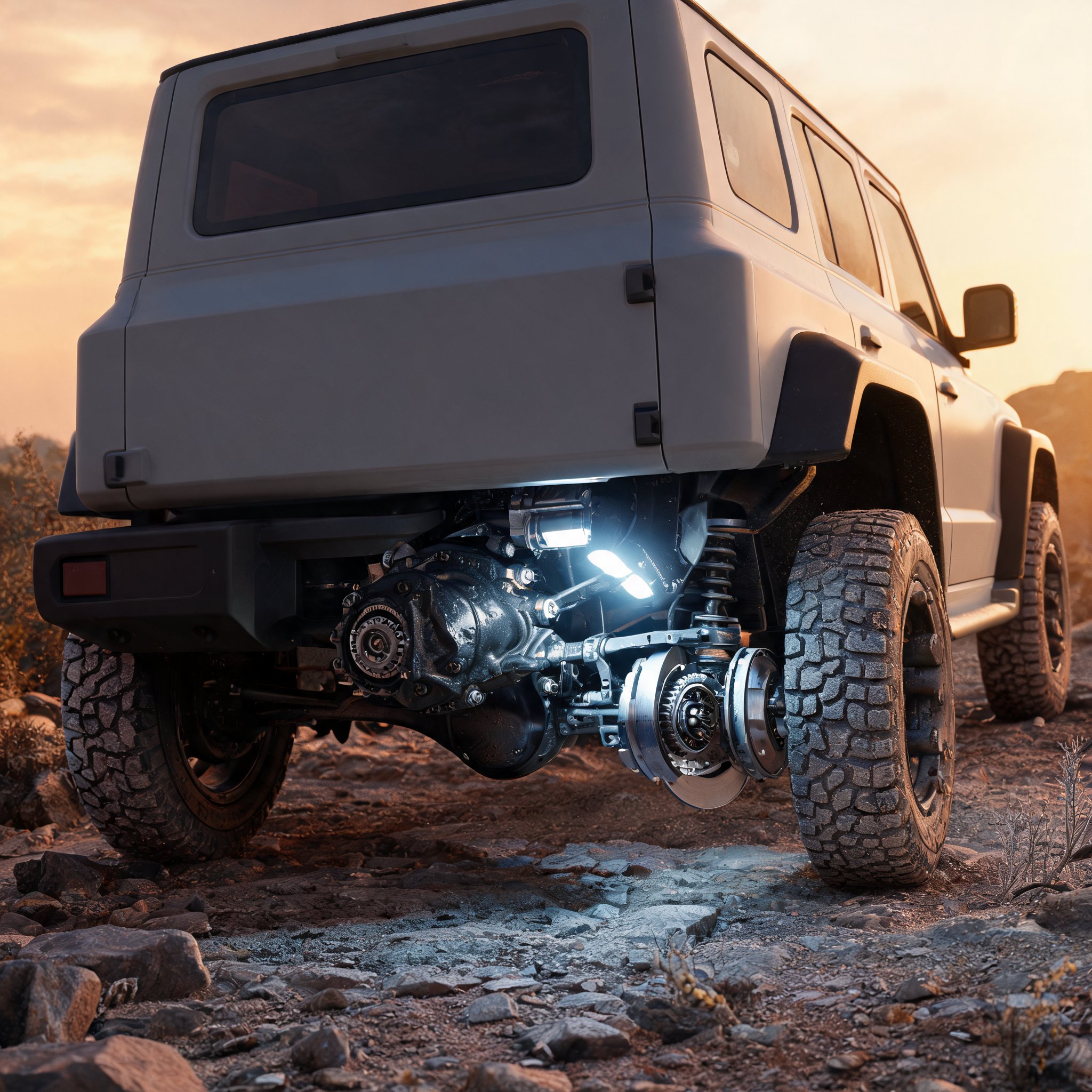
Portal axles are admired in hardcore off-roading because they lift a vehicle’s drivetrain without forcing the axle shafts to hang low beneath the frame. A set from specialists such as 74Weld typically costs around $20,000, putting the hardware well beyond many enthusiasts. Zeph Gage’s rear-only conversion for an XJ Jeep takes a different route: it costs roughly one-fifth of that figure by combining a Ford 9-inch axle housing with Humvee geared hubs and HMMWV portal adapters from Jesse Haines Fabrication.
The central problem is direction. Two-gear portals like the Humvee units reverse the rotation of the input shaft. To make the Ford 9-inch work with them, Gage flipped the differential upside down so the driveline turns the correct way. A Yukon Gear and Axle third member is then bolted to the differential, turning low-pinion components into what functions as a budget high-pinion arrangement.
Clearance gains without giving up shock travel
The conversion adds about six inches of clearance, but its benefits are not limited to height. It also preserves full shock travel, a packaging challenge that can be difficult with portal axles, and is intended to reduce stress on the differential itself. The resulting arrangement is expected to be effectively bulletproof.
Gage installed the portal only at the rear and kept the front solid axle. That choice mirrors a common approach in remote-control rock crawlers. Retaining the front axle avoids the packaging constraints that often appear when portal hardware is added to a vehicle that never had it from the factory. It also means shock travel does not have to be restricted to make room, and the Jeep’s ride height does not rise to an extreme level. The compromise aims to keep the advantages of both layouts.
Custom fabrication, not an off-the-shelf kit
This is not a bolt-on package. The build required homemade brackets, custom-tapped plates and a two-piece brake rotor matched to a Ford Fusion caliper. Gage chose the Fusion hardware partly because it has an integrated electric emergency-brake solenoid, and partly because it helped with clearance. Those details show how much adaptation sits behind the relatively simple idea of turning the differential over.
On the vehicle, the payoff is visible in obstacle clearance: the XJ can drive over a five-gallon bucket and still have several inches of space to spare. That matters when the rear end would otherwise catch on an obstacle that the front wheels can steer around. The rear-only layout gives the Jeep a useful clearance advantage without forcing a complete front and rear portal conversion.
The build also highlights the cost gap between mainstream portal-axle products and a carefully engineered DIY alternative. It is not a universal solution, and the fabrication demands are substantial. But for a dedicated builder, reusing proven Humvee gears and a Ford 9-inch housing—then correcting the driveline direction with a flipped differential—offers a way to gain portal-style clearance at a fraction of the usual price.