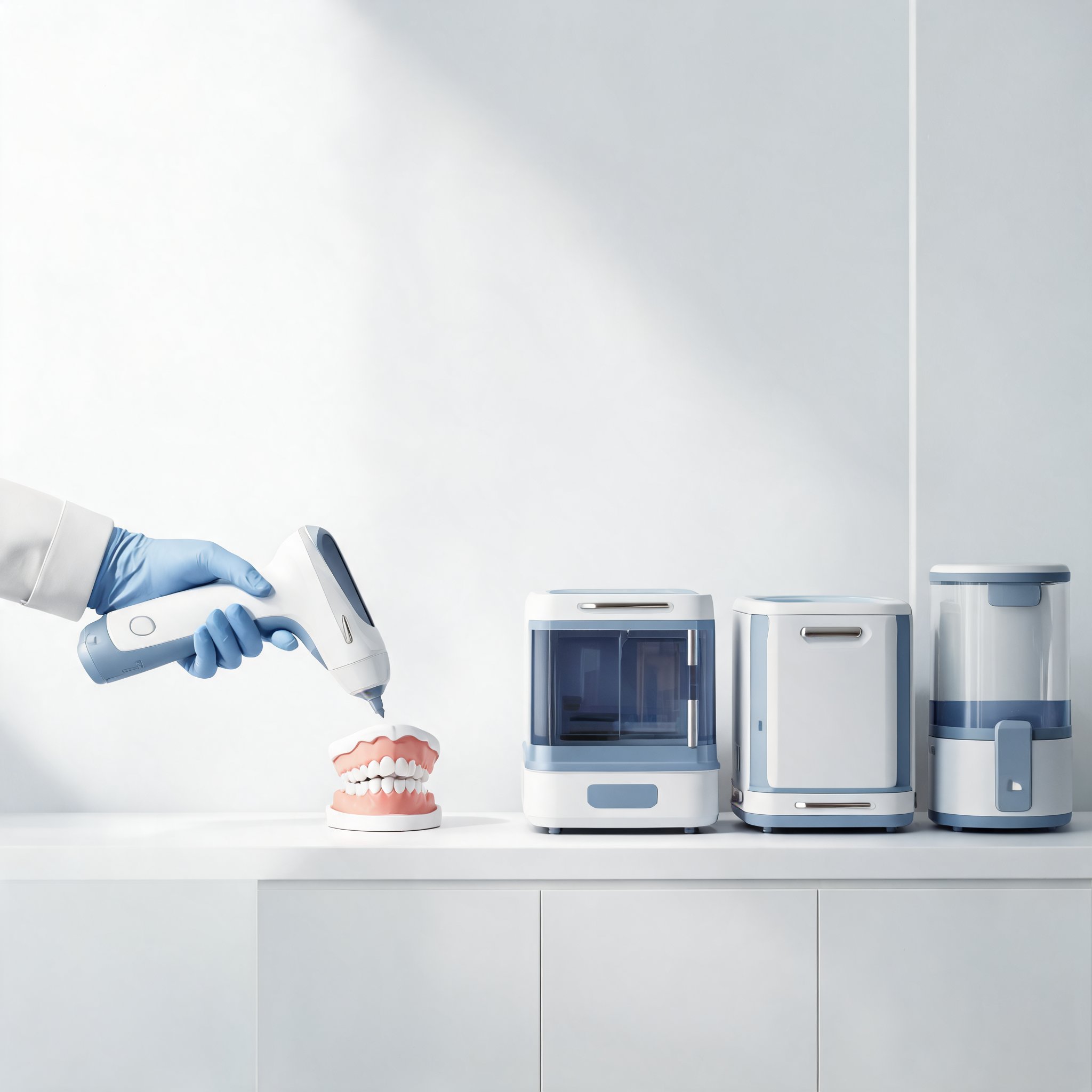
SprintRay used 3DNext 2026 in Miami Beach to expand its digital dentistry platform on three fronts: a wireless intraoral scanner built for ScanOS, a compact chairside production line called the Nano Series, and a widened materials partnership with GC Corporation. The company said it has produced more than 20 million dental parts worldwide.
According to SprintRay, the additions extend a connected workflow running from scanning and design through production and post-processing. The company framed the announcements as a response to practices that previously had to move between separate systems to complete those steps.
Foundation scanner built for ScanOS
The scanner, named Foundation, is a wireless, full-colour intraoral device built for ScanOS. SprintRay says it brings scanning into the same account and interface used for design and production, allowing a practice to move from digital capture to a finished case without a separate file export or upload step after scanning. It is set to launch officially in the United States, with first shipments expected in November 2026.
"For years, we connected scanning and printing through third-party integrations, but the experience still required practices to move between systems," said Amir Mansouri, Ph.D., co-founder and CEO of SprintRay. "ScanOS makes scanning a native part of the SprintRay workflow, and Foundation is the first intraoral scanner built for it."
Nano Series aimed at single-case chairside work
SprintRay says the Nano Series is intended for the estimated 80% of chairside print jobs that involve a single patient and a single case. The line comprises three connected units:
- NanoPrint — a printer using a 385 nm light engine;
- NanoWash — automated washing and drying;
- NanoCure — post-processing to complete the workflow.
The print, wash and cure sequence is designed to occupy less than 30 inches of counter space. AutoPrint and Job Handoff are intended to connect production steps and carry case information through the workflow, and the series draws on SprintRay's validated materials library, with specific indications and availability varying by market.
"We designed the Nano Series to make chairside production more intuitive and practical for the dental team," Mansouri said. "It brings the workflow together in a compact footprint while maintaining the standards clinicians expect from SprintRay."
Shipments are expected to begin in November 2026 in the United States, Canada, Australia, New Zealand and the European Union, subject to applicable regional regulatory requirements and product availability. SprintRay noted that NanoWash is not part of the Canadian launch offering.
GC hybrid ceramic resin for Midas Digital Press
The third element is a materials collaboration with GC Corporation. GC GRADIA PREMi, a new hybrid ceramic restorative resin developed for the SprintRay Midas Digital Press workflow, has been launched. The companies say the partnership pairs GC's restorative materials expertise with SprintRay's capsule-based Digital Press platform, with the aim of widening material options for definitive chairside restorations. Specific clinical indications, performance claims and regional availability remain subject to GC's final approved product labelling and regulatory review.
"Openness matters, but so does validation," Mansouri said. "Our approach is to work with leading partners to broaden what clinicians can do while maintaining rigorous workflow standards."