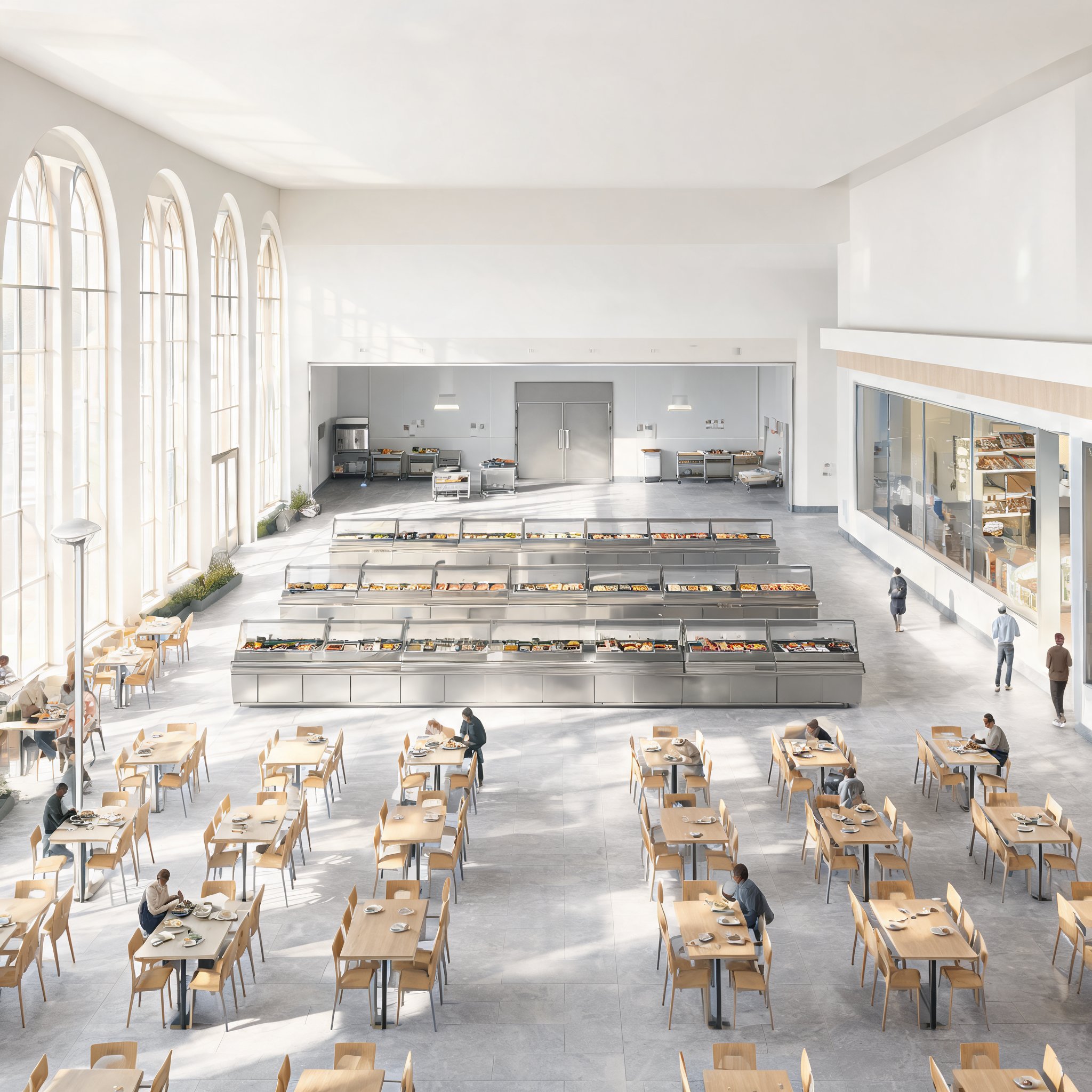
Texas Christian University did not treat the renovation of its Market Square dining facility as a cosmetic refresh. The Fort Worth university set two operating goals for the nearly 18-year-old space: create a destination for students and raise meal-plan participation to keep pace with expected growth. BLUU Dining, which opened in August 2026 inside the Brown-Lupton University Union, is the result. The project is part of a $17 million overhaul of the union and combines a roughly 13,000-square-foot dining hall with about 4,500 square feet for food platforms and back-of-house space. It seats 550 indoors and 120 on a patio, and it has eight food platforms, including a to-go window.
The early operating numbers explain why the project is worth examining beyond its finishes. Less than two months after opening, BLUU Dining was averaging 4,000 meals per day, double the meal counts recorded when the old facility closed for renovation in December 2025, according to Jude Kiah, associate vice chancellor for student affairs business and operations. A peak day reached about 5,700 meals. Kiah estimated that, if pressed, the operation could produce around 8,000 meals per day. Those figures are early and include an estimate, but they point to a design intended to shape demand as well as serve it.
Designing for made-to-order demand
Planning began in 2022 with surveys of student satisfaction. Kiah said analysis across multiple surveys showed that the complaint was the facility, not the food. Students saw the old hall as a self-serve cafeteria with premade food. They also valued made-to-order service over speed and were willing to wait for customized meals. Kiah said the team conducted at least six surveys and focus groups before trusting the pattern. The new hall, in other words, had to make customization visible and keep queues moving even when they grew deep. Kiah recalled a 15-person bowl queue in which the last customer was served in four minutes and 30 seconds.
Layout, flow and a to-go window
The design team moved the salad, deli and to-go platform away from the main servery area to give the remaining platforms more room. Placed near a wall of windows overlooking the campus and stadium, the platform became the most popular space in the facility, Kiah said. Its Dash to-go window opens into the entrance hallway, allowing time-pressed guests to pick up a premade sandwich or salad without entering the servery. Kiah described it as a way to capture seating demand, add options and potentially operate late into the evening with little labor input.
Back-of-house traffic received comparable attention. Miles Oller, director of facilities and operations, replaced a narrow passageway with a wide service corridor that has individual entrances to every platform, reducing competition for space. Oller said the front-of-house transformation is visible, but the operational core of the renovation is the ability to move product safely and efficiently from one point to another.
Equipment chosen for uptime
The support kitchen and walk-in cooler were rebuilt as part of the project. Epoxy flooring replaced old tile, and because everything had to be removed for the floor work, the team examined 15-year-old equipment and undertook a one-for-one replacement of nearly all of it. A new 800-square-foot walk-in cooler lets staff roll pallets directly inside, unload onto carts and distribute product where needed. Scott Majestic, Sodexo district manager, said the goal was to streamline receiving and distribution.
Front-of-house equipment was selected for capacity, flexibility, maintenance needs and training needs. The rotating pizza oven is a clear example: it can produce 116 pizzas an hour and bake casserettes on a lower level, with one worker loading from the front and another unloading from the side, so no one has to reach into a 550-degree oven. Other choices include a customer-facing soft-serve machine, a round griddle that also works as a plancha, and a pasta station that can pivot to breakfast. In general, the team favored robust, low-tech units over computer-controlled equipment. Oller noted that some 30-year-old oven ranges from the original makeover were still working, and the new pieces came from the same supplier. The team also avoided certain griddle and warewasher brands because of repair difficulties, and asked its service company to research future parts costs before selecting new equipment.
What the early results do and do not show
The broader context is growth. TCU opened East End, a dining hall on the opposite side of campus, in January 2025, and the same dining team led BLUU Dining's renovation. Meal-plan enrollment currently stands at 6,300, with expectations of surpassing 8,000 in the coming year. The university plans to add 2,500 beds on campus next fall. Kiah said the new hall needed to establish its own draw alongside East End and is doing so.
The evidence supports a clear operational conclusion: the renovation removed barriers between student demand and service. Made-to-order platforms, a separate grab-and-go path, a service corridor that separates product movement, and equipment chosen for uptime all reinforce one another. But the results are early. Less than two months of meal counts, a single peak day and an estimate of 8,000 daily meals do not establish long-term financial returns, sustained student satisfaction or a maintenance record. The model also depends on menu execution, staffing, student mix and capacity discipline, so it is not automatically transferable to every campus.
An operating system, not just a dining room
BLUU Dining shows how architecture, menu format, back-of-house logistics and equipment reliability can be aligned around a measurable goal. The $17 million union project delivered a brighter hall, more seats and a patio, but the more important change is the operating system behind them. If the early traffic holds as TCU adds beds and raises meal-plan targets, the renovation will be judged less by its opening novelty than by whether those choices keep meals moving at peak. For now, the university has a strong early signal and a clear set of operating questions.